

http://127.0.0.1:8000 with your evals listed but not yet run. Add --run to start running them straight away, or pass a saved run file to reopen it. See ezvals serve for all flags.
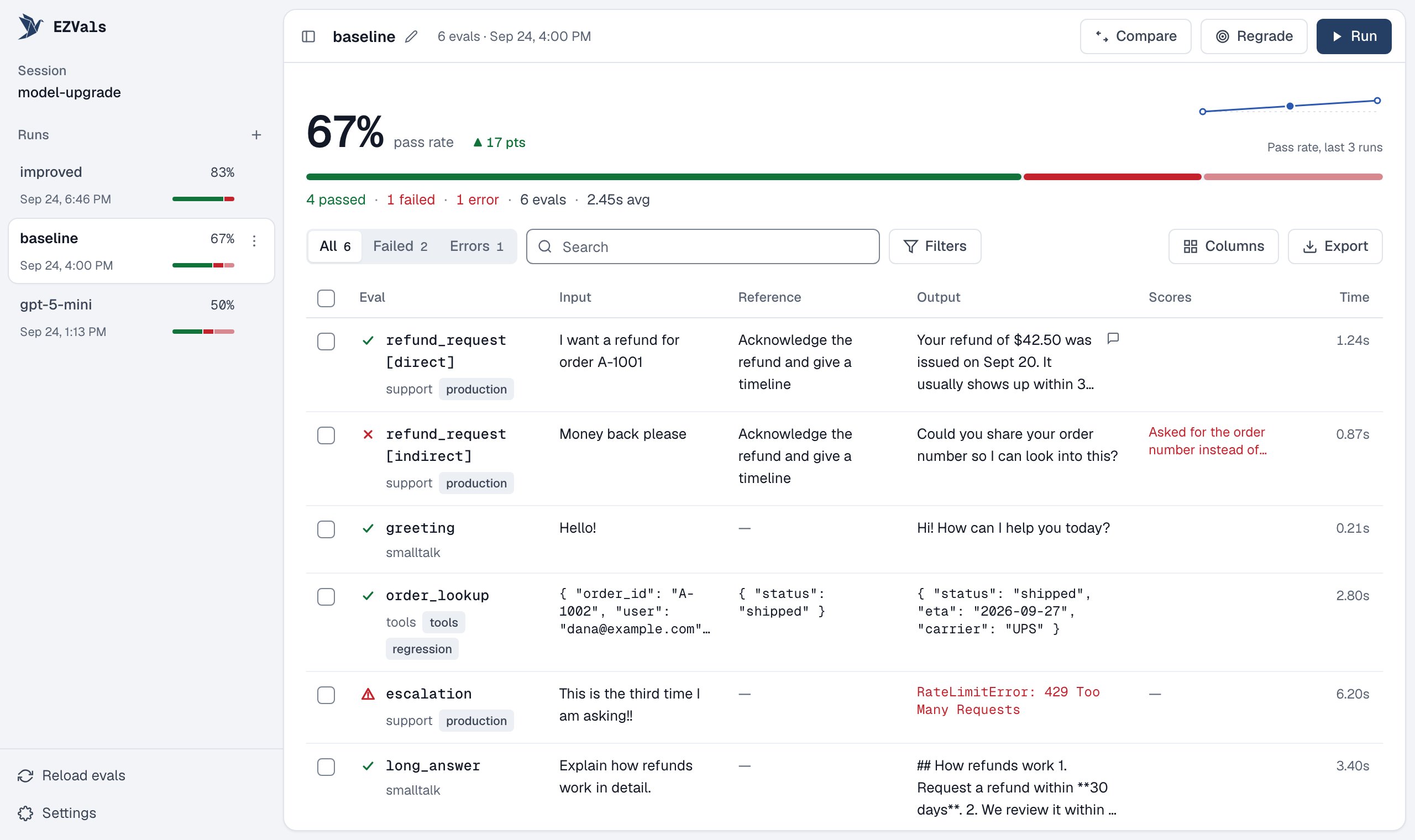
The sidebar lists the session’s runs, newest first, each with its pass rate. Click one to open it; its ⋯ menu compares it with the open run, renames, copies or deletes it.
Run evals
- Run runs every eval, or only the rows you’ve selected. Results stream in as each eval finishes.
- While a run is going, you can pause it (running evals finish, queued ones wait) or stop it (everything unfinished is cancelled).
- Running again replaces those rows’ results in the current run and keeps your annotations. To keep the old results, start a new run with + in the sidebar. It gets a fresh name in the same session.
- Every run uses your latest code, so edit an eval and run it again without restarting the server. To pick up new eval files or
ezvals.jsonchanges, use Reload evals at the bottom of the sidebar. - Regrade scores the stored outputs again without calling your agent. See Regrading.
- Settings, also in the sidebar, sets concurrency, timeout, trials, where runs are stored, completion notifications and the theme. Saving writes them to
ezvals.json.
Review failures
The summary above the table shows the pass rate, counts, average latency and a bar of passed, failed and errored rows, plus pass@k and pass^k for trials. If your evals store more than one score, each score key gets its own stat beside the pass rate, and the table shows which checks failed. When the session has an earlier run, it also shows how much the pass rate changed since then, and a small chart of the pass rate across the session’s runs. To narrow the table:- Switch between all rows, failures only, and errors only.
- Search. You choose which columns search looks in.
- Filter by dataset, label, score, or whether a row has an annotation, error, trace URL or messages.
- Sort by score.
edge-case label?”. Filters are kept when you open a result and come back.
Open a result
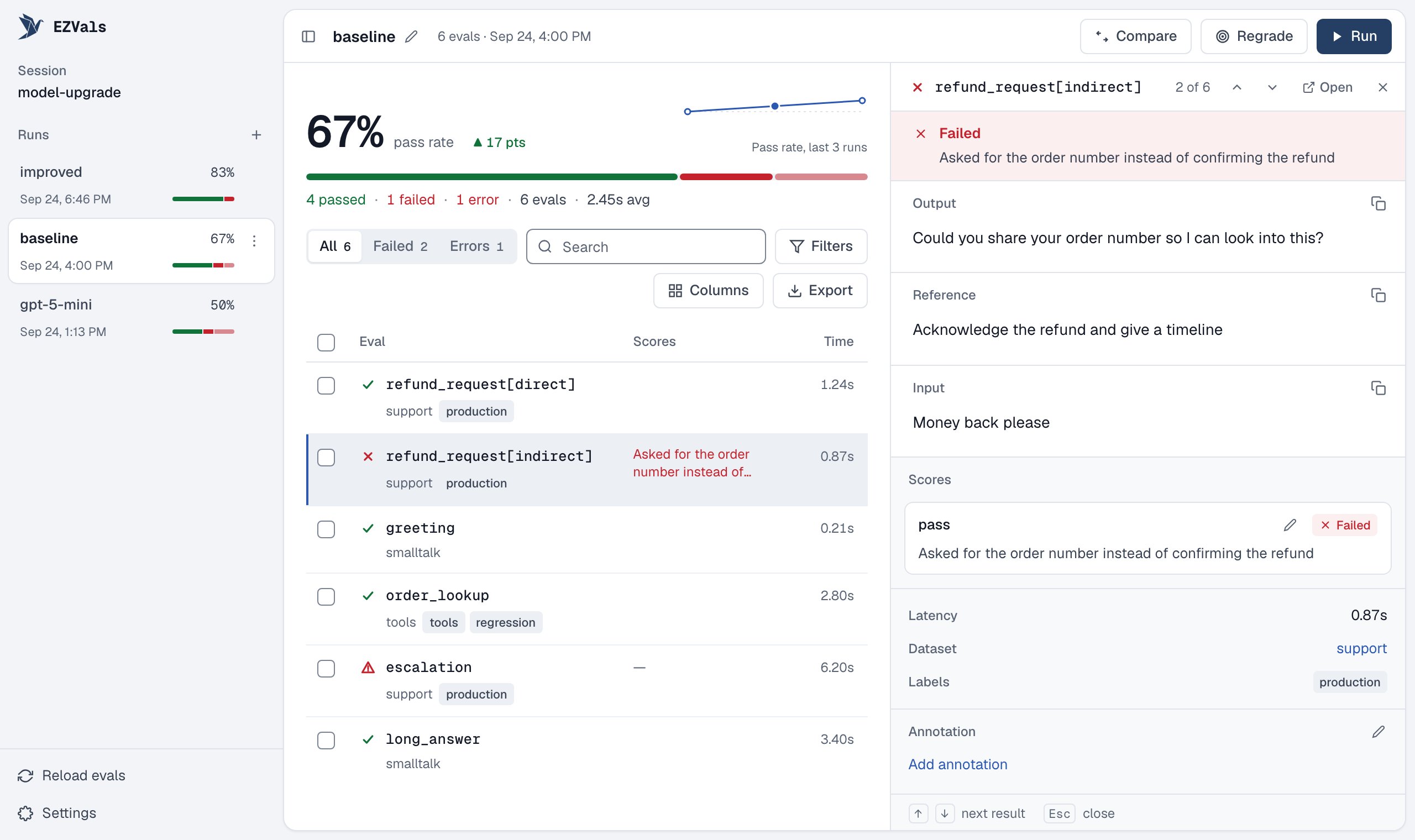
Click a row to read the result in a panel beside the table, so you keep your place in the run. Use ↑ and ↓ to step through the results, and Esc to close the panel. Press Enter, click Open or click the eval’s name for its full page. Both mark the outcome with an icon beside the eval name, and a result that errored gets a strip at the top with the error and its traceback. Below that:- the output, the reference and the input (side by side on the full page, so you can compare them); chat transcripts render as conversations (you can switch to raw JSON)
- scores with their notes, which you can correct
- metadata, the tools the agent used, latency and extra trace data
- a link to the trace, if you stored a
trace_url
Annotate and correct scores
When you disagree with a grader or want to leave a note for later, edit the result directly:- Annotations are free-text notes, such as “hallucinated the refund policy”. They’re kept when the eval runs again.
- Score edits change a score’s pass/fail or value when you judge the grader was wrong. They’re replaced the next time the eval runs or is regraded.
correction_history with the before and after values, so you (or a coding agent) can see where your judgment and the grader’s differ, and use that to tighten the grader.
Compare runs
Compare shows up to four runs from the same session side by side. Start it from Compare in the header, a run’s ⋯ menu in the sidebar, the pass-rate change in the summary, or withezvals serve --compare-runs baseline,improved.
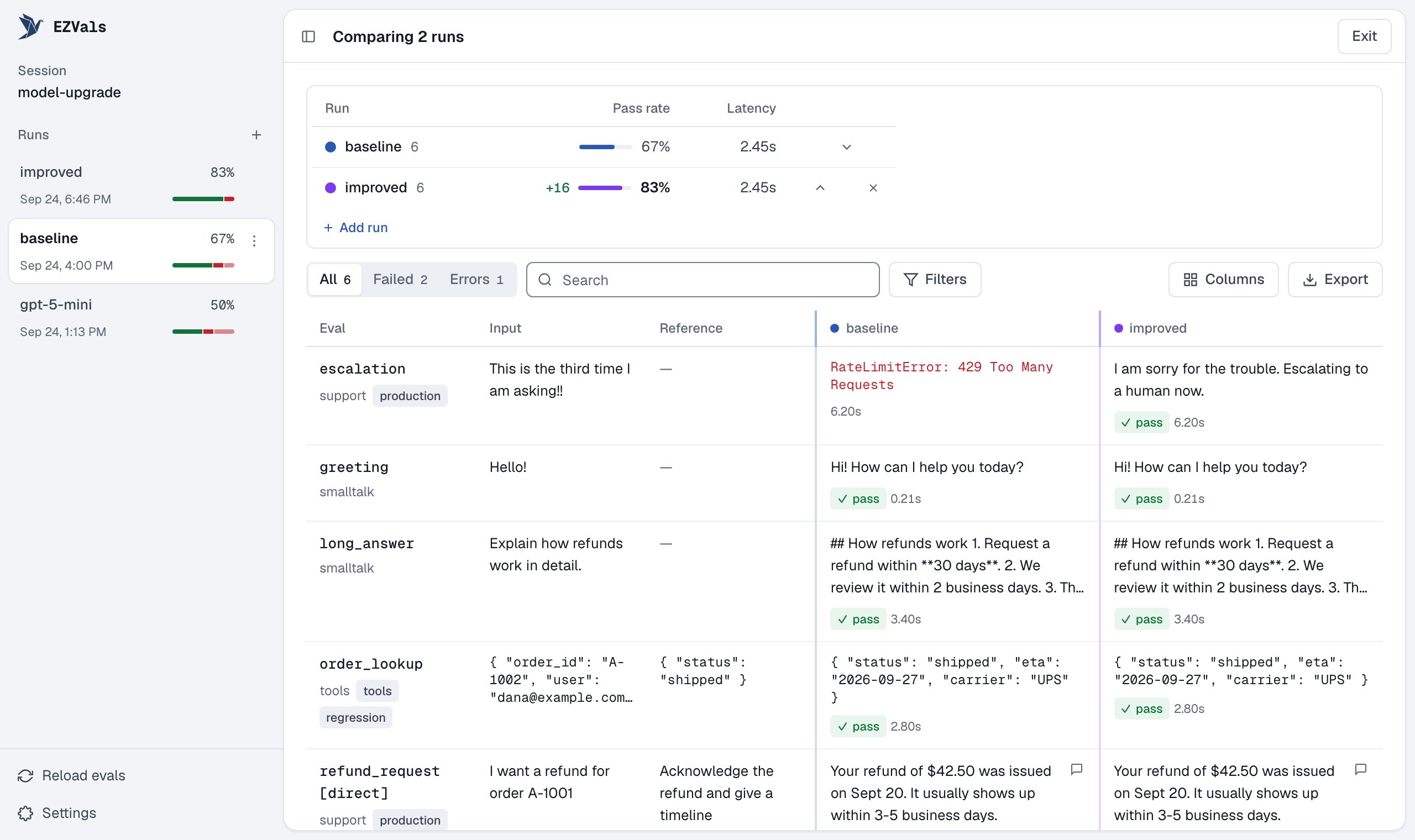
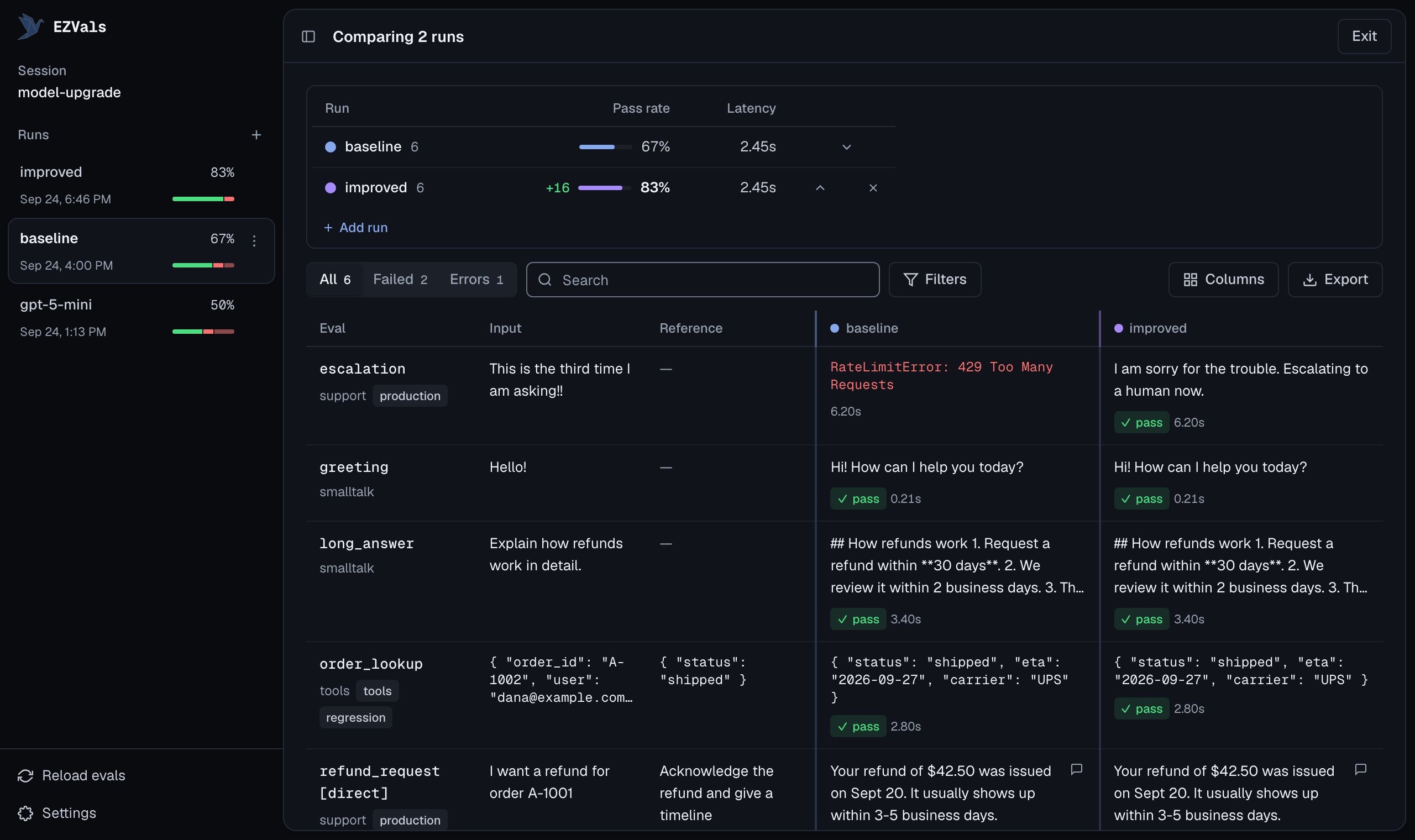
- The summary becomes a table with one row per run: its pass rate (and how much it changed from the first run), any other score keys and latency, with the best value in each column highlighted.
- The results table gets one column per run, with each run’s output, scores and latency. Rows are matched by eval name and dataset, and a dash marks an eval that isn’t in a run.
- Opening a result shows every run’s output for that eval next to each other.
- You can add, remove and reorder runs. Running is disabled while comparing.
Export
JSON, CSV and Markdown are also available from the command line with
ezvals export. The image is only in the UI.